
The dead cat and everything else
27th - 30th August 2026
Opening: Thursday 27th August 18:00 - 20:00
Cecilia Sjoholm, David Micheaud, Iain Hales, Nicky Hirst, Sarah-Kate Wilson, Thomas Pellerey Grogan and
Emma Gradin.
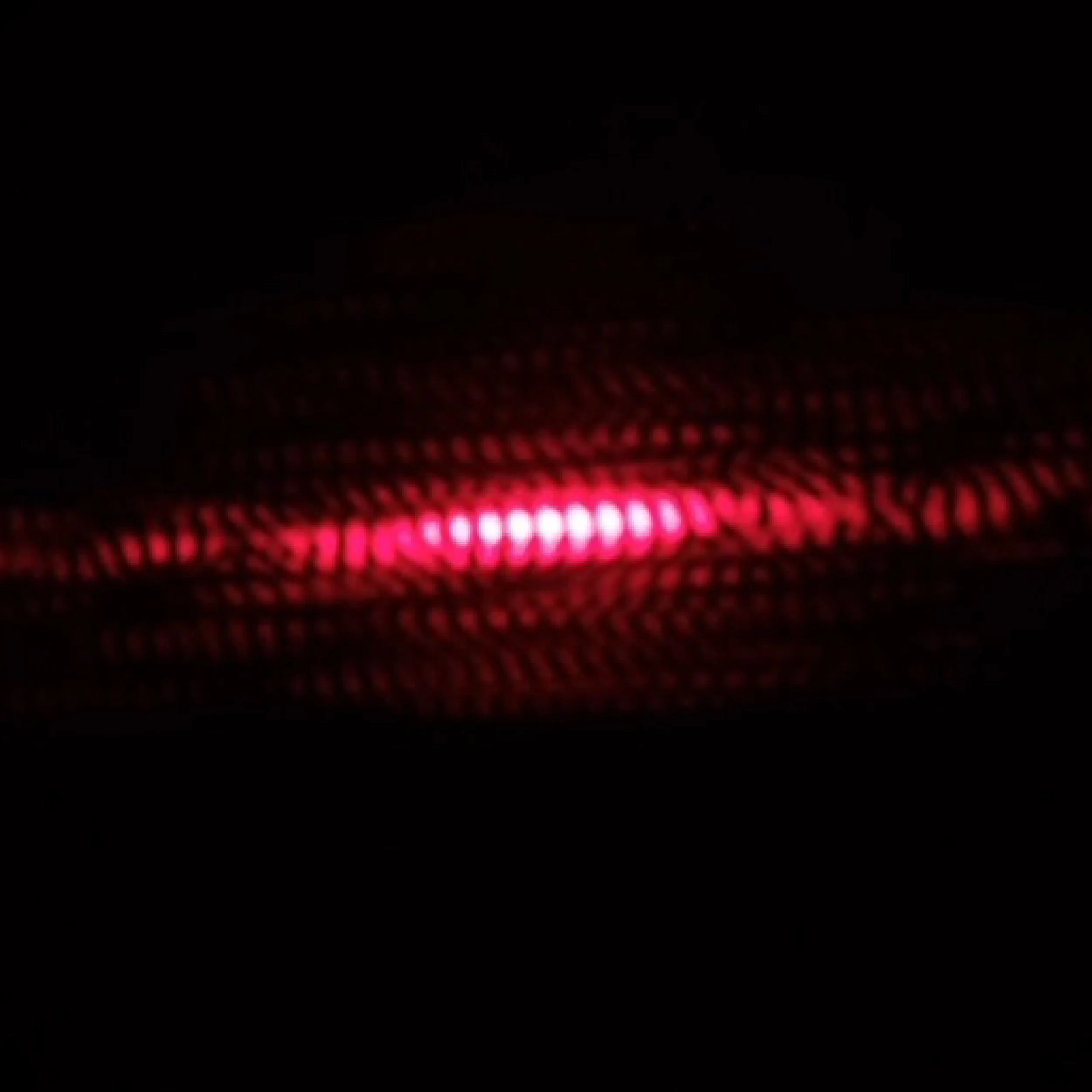
The dead cat and everything else… takes the theorem of Superposition – that an object (particle) can exist in multiple states simultaneously – and uses that notion to examine artworks that can be said to occupy two or more “states” concurrently.
The dead cat and everything else… a group exhibition featuring the work of Cecilia Sjoholm, David Micheaud, Iain Hales, Nicky Hirst, Sarah-Kate Wilson and Thomas Pellerey Grogan.
In 2025, quantum physics celebrated its 100th birthday. The German physicist Werner Heisenberg’s eureka moment came in 1925, deciding to look at a problem from a completely new angle he left the “absolute certainty” of classical physics and concluded that in physics uncertainty does exist – but that its probability can be calculated to great accuracy.
In 1926, the Austrian physicist Erwin Schrödinger published his own independent research along the same lines and in 1935 he devised his, now famous, thought experiment, which has come to be known as ‘Schrödinger’s Cat’. The experiment is an illustration of what he saw as the absurd implications of quantum theory when applied to macroscopic objects like a cat.
The experiment uses a hypothetical cat in a box to illustrate the quantum mechanical principle of superposition, where a particle can exist in multiple states at once until observed. A cat is placed in a sealed box with a radioactive atom, a Geiger counter, a hammer, and a vial of poison. The radioactive atom has a 50% chance of decaying and a 50% chance of not decaying within a specific timeframe. If the atom decays, the Geiger counter detects it, triggering the hammer to break the vial of poison, which kills the cat.
If the atom does not decay, the cat remains alive. According to quantum mechanics, until the box is opened, the radioactive atom exists in a superposition of being both decayed and not decayed at the same time. Since the cat’s fate is tied to this quantum event, the cat is also considered to be in a superposition of states – both alive and dead simultaneously. It is not simply a matter of not knowing the cat’s state, the cat is in a combination of both states at once.
We would like to take the theorem of superposition – that an object (particle) can exist in multiple states at once – and use that notion as means to explore art and art practices where an artwork can be said to occupy two or more “states” concurrently. This sense of multiplicity within individual artworks will extend into examining the relationships between the various works within the exhibition. What connections exist and, conversely, do not exist at the same time; what is the physical reality and what is purely notional. More importantly, can the combination of artworks trigger further interpretations?
It can be argued that each of the artists in this exhibition make work that sits in a “superposition” – sculpture that exists as both an object and image; paintings that explore nature’s markings, both the insides and outsides at the same time; explorations of scale where an extreme close-up becomes a landscape; and objects that are both functional and dysfunctional, familiar and rendered into unfamiliarity. And what effect does the audiences’ observation have on these works? Does viewing the work, much like opening Schrödinger’s box, cause the system to “collapse” into one definite state and /or what chain reaction might that produce?
We are at the beginning of what may be called quantum physics’ second revolution, which will have major impact on technology moving forward into the future. On an existential level, the world seems to be approaching a radical transformation – will the world remain understandable or will it transmute into something unrecognisable. As such, exploring theorem of superpositions obliquely, via the means of art, feels incredibly timely.
Events:
Sunday 30th August @ 14:00
In-conversation, chaired by Emma Gradin, with artists Cecilia Sjoholm, David Micheaud, Iain Hales, Nicky Hirst, Sarah-Kate Wilson and Thomas Pellerey Grogan.