
SANDCASTLE
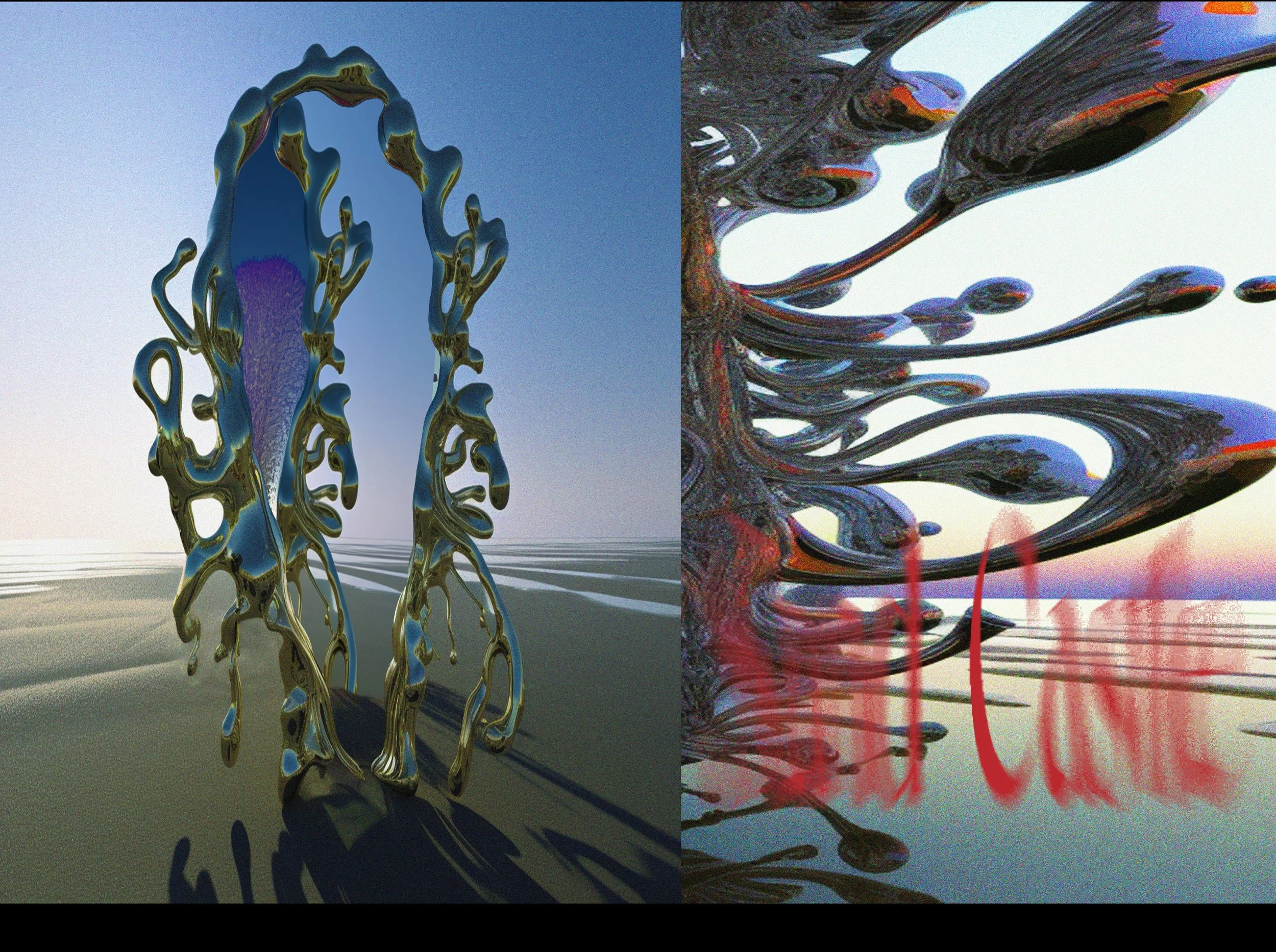
3 - 13 August 2023
Opening: Thursday 3rd August 18:00-20:00
Anna Brass, Laura Bygrave, Alex Crocker, Paul Fenner, Grant Foster, Mary Furniss, Sarah Gillies, Lee Grandjean, Ken Kiff, Holly Mills, James Metsoja, Ross Taylor & Tom Woolner
Events
Saturday 22 July 14.00-16.00
Deptford Drawing Walk - ‘Towery city and branchy between towers’
A free drawing workshop open to all ages, no drawing experience required. We will lead the group along an accessible route starting from the gallery. As we walk along participants will be encouraged to look up at the roof-line of the buildings, at the trees, birdlife, people, street furniture, objects, weeds and paving-slabs. We will make an ‘inventory’ drawing, picking out the different types of objects we see as we go along.
The digital space places us at a juncture. We are free to explore multiple facets of self, yet we know a person only through their carefully curated shadows. SANDCASTLE shows work from six artists exploring ‘multi persona’ in a digital age.
Under the burning sun, a boy squats in the sand, fiercely focused on building a sandcastle at the beach. Blazing sunrays pierce through the carelessly applied sunblock on his back. His skin swells and peels as it burns. But the child’s senses have been completely overridden by his task. In the world, it’s just him and his sandcastle. And then suddenly he hears a merry tune. It’s the ice cream van. The boy leaps up and runs towards the van, calling to his mum. She buys him an ice cream which he enjoys immensely. Once satisfied, his thoughts return to his sandcastle. But as he surveys the beach, he cannot find it. It’s gone. Where has it gone? Did a wave wash it away? Has his older brother sabotaged him? Or did some spiteful old man drop-kick it while walking his dog? ‘Where is my sandcastle?’ the boy cries out. ‘Oh darling, it’s just a sandcastle. You can always build another one,’ his mum says, resting her hand on his shoulder. He looks up at her forlornly. ‘It’s not just a sandcastle, Mummy. It was my pErSoNa.’
South Korean bloggers identified ‘multi persona’ in 2021 as a social trend that destigmatised the idea of having multiple selves and allowed people the freedom to self-express numerous facets of their identity, especially online. This trend is traceable across the globe. Although its presence cannot be exclusively claimed by our contemporary digital moment, there is a strong argument that the internet has taken our need to constantly create various ‘self-brands’ to a new level of intensity (Cornell 2015, p.38). Dating apps reveal our romantic and sexual selves, our nerdom is cultivated and accentuated in niche forums, and our reputations are shaped through online professional networks. Consciously and subconsciously, we curate our image on various social media platforms, creating an assortment of personas that we carefully exhibit to the multiple worlds watching us. ‘Multi persona’ in the digital age places us at an uncomfortable juncture in human perception. On the one hand, a person is accepted as a complex and multi-faceted being and their freedom to be so is celebrated. On the other hand, we ‘know’ a person other only through the shadows they allow their onlookers to see. Photo after video after caption, the internet is an endless cycle of first-person narratives feeding into a torrent of visual data. Is this information even meaningful? Or, as art philosopher Jean Baurdillard puts it, is each new digital image merely a ‘simulacrum’ – a representation of another representation, part of a steady distancing from an original meaning within a stream of endless image-making (Emerling 2006, p.89)? Indeed, as filmmaker Guy Debord describes, we are arguably living in the Society of the Spectacle, wherein our social relationships are mediated by images (Debord 1994, p.12). We might consider what the implications of this are for human relationships. How might this notion of the ‘spectacle’ have been enhanced by digital technology? And how are social power dynamics affected by an image-based society? The freedom to build infinite sandcastles is a great one, but sand is fragile, the beach is vast, and the tide comes in quickly. Is all this building a futile effort? SANDCASTLE shows the work of six artists exploring ‘multi persona’ in a digital age.